Showing posts with label chemistry. Show all posts

Materials Science of Polymers for Engineers 2E Review

Materials Science of Polymers for Engineers 2E
Average Reviews:

(More customer reviews)
Are you looking to buy Materials Science of Polymers for Engineers 2E? Here is the right place to find the great deals. we can offer discounts of up to 90% on Materials Science of Polymers for Engineers 2E. Check out the link below:

>> Click Here to See Compare Prices and Get the Best Offers

Materials Science of Polymers for Engineers 2E ReviewDon't hope to find matters deeply explained. It is an execllent book that covers too many topics on polymer science. It has a little about almost everything! It's worth the price!Materials Science of Polymers for Engineers 2E Overview

Want to learn more information about Materials Science of Polymers for Engineers 2E?

>> Click Here to See All Customer Reviews & Ratings Now
Read More...

The Reproduction of Colour (The Wiley-IS&T Series in Imaging Science and Technology) Review

The Reproduction of Colour (The Wiley-ISandT Series in Imaging Science and Technology)
Average Reviews:

(More customer reviews)
Are you looking to buy The Reproduction of Colour (The Wiley-IS&T Series in Imaging Science and Technology)? Here is the right place to find the great deals. we can offer discounts of up to 90% on The Reproduction of Colour (The Wiley-IS&T Series in Imaging Science and Technology). Check out the link below:

>> Click Here to See Compare Prices and Get the Best Offers

The Reproduction of Colour (The Wiley-IS&T Series in Imaging Science and Technology) ReviewThe author has an impressive array of initials after his name; he is, amongst other things, a Doctor of Science, a Member of the Imperial College, an Associate of the Royal College of Science, and a Fellow of the Royal Photographic Society as well as a Visiting Professor of Physiological Optics and of Colour Science, and a former Assistant Director of Research at Kodak. He has also been Chairman of the Colorimetry Committee of the International Commision on Illumination, and Chairman of the International Colour Association.
First published in 1957 and now in its much enhanced 5th edition, The Reproduction of Colour is the most comprehensive single resource available. Two quotes from the preface to the 5th edition describe what it is about:
"The object (is to present) the fundamental principles of colour reproduction, whether by photography, television, or printing in the hopes that all those engaged in producing, selling, buying, or using colour pictures will be able to see the nature of the problems they encounter. Those who want a general statement on colour reproduction will find it in the first part, and those who want a more detailed discussion of any one application in which they are particularly interested (will find it) in the later parts." and "The reproduction of colour involves physiology, psychology, physics, chemistry, and technology. presents complexities, (and) involves a wide variety of enterprises". Even though there are individuals skilled in processing and printing their own color film, and DTP bureaux had taken over some of the work of traditional printing houses, color reproduction was, until not so long ago, the province of technicians in the photographic, printing, and television industries, Now we have crossed the threshold of a new era in which a massive technology transfer is taking place, putting effective control over color into the hands of a much wider range of users. Even home users now have available to them very powerful tools that enable production of images that are, to the ordinary eye, indistinguishable from quality photographic prints.
That brings with it a need to understand the technology of color reproduction, and the definitive text is Dr Hunt's book. I have rated it 10/10 because of the remarkably wide range of disciplines covered and its astounding technical depth. Without it most of the information presented would have to be gleaned from numerous other books, professional journals, and published papers. Further, one does not have to have a scientific background to gain some understanding of what is involved in the reproduction of color. The fields covered television, photography, and printing are becoming less discrete with the application of digital technology; those who use computerized systems for the reproduction of color images will find relevant information spread throughout most parts of this book.
It is not a popular account, a color-for-cretins guide, or a how-to manual. This is a technical resource written in a style that makes it readable without diluting its professional integrity. Not all readers will need, or even want, to know the chemical structure of cyclic methylene magneta couplers, but may want information about the effects of signal processing on color reproduction. In what other recently published text would one find a comparison table of film speeds that includes the Weston system?
The Reproduction of Colour should be in any library with holdings on technical subjects; professionals in DTP, printing, photolabs, television, and digital imaging should have it; and anyone teaching or studying graphic arts, computer science, photography, printing, or subjects related to television technology should be aware of this edition. A check of some large libraries suggests that librarians may think earlier editions are good enough, but new developments demand this latest edition. Teachers of science in sub-tertiary institutions may well find this a useful text for its practical application of science to topical real-life problems.
The book is divided into parts: Fundamentals, Color Photography, Color Television, Color Printing, and Evaluating Color Appearance. Each chapter opens with an introduction that provides a succinct overview of the topic. Reviewed by Major Keary [majkeary@netspace.net.au]The Reproduction of Colour (The Wiley-IS&T Series in Imaging Science and Technology) Overview

Want to learn more information about The Reproduction of Colour (The Wiley-IS&T Series in Imaging Science and Technology)?

>> Click Here to See All Customer Reviews & Ratings Now
Read More...

Practical Bomb Scene Investigation, Second Edition (Practical Aspects of Criminal & Forensic Investigations) Review

Practical Bomb Scene Investigation, Second Edition (Practical Aspects of Criminal and Forensic Investigations)
Average Reviews:

(More customer reviews)
Are you looking to buy Practical Bomb Scene Investigation, Second Edition (Practical Aspects of Criminal & Forensic Investigations)? Here is the right place to find the great deals. we can offer discounts of up to 90% on Practical Bomb Scene Investigation, Second Edition (Practical Aspects of Criminal & Forensic Investigations). Check out the link below:

>> Click Here to See Compare Prices and Get the Best Offers

Practical Bomb Scene Investigation, Second Edition (Practical Aspects of Criminal & Forensic Investigations) ReviewThe global war on terror has increased the need for post blast investigation and training. Within the United States, an ever increasing number of bomb incidents involving juveniles, enmity, drug operations, organized criminals, and traditional criminals is seeing the need for post blast investigations spread to the smallest, most remote communities. Unfortunately, access to training has become limited, as traditional sources, such as the FBI and ATF, must address budgetary constraints and their own operational needs.
At a most opportune time, CRC Press has published James T. Thurman's Practical Bomb Scene Investigation. Thurman, an associate professor at Eastern Kentucky University, is well known within the bomb response community as the retired chief of the FBI's Explosives Unit and Bomb Data Center, putting him at the forefront of bomb response, intelligence sharing, and training in the U.S. He has combined his experience, education, with an ability to write in a very readable manner to produce a valuable guide to this field.
In the U.S., the FBI, ATF, Postal Inspection Service, Department of State and other agencies teach very similar post blast investigative techniques. Thurman maintains this documenting the team approach taught by these agencies. The team includes crime scene investigators, laboratory analysts, bomb technicians, and general investigators. Much of the physical crime scene procedure will be familiar to experienced members of the criminalistic fields - photography, sketch documentation, search techniques, and evidence collection techniques. Other aspects, however, will be new - establishing the search parameters, packaging materials for explosive residues, safety aspects, etc. Thurman covers these and many more related areas in a manner which is highly informative.
Important aspects of post blast investigation include recognition of components and understanding the technology of bomb functioning. Thurman does an outstanding job of introducing the reader to explosives, components, and function. He includes much detail on the subjects, providing the previously ignorant a wealth of insight into the construction of bombs, function of explosives, and the variety of types of explosions. Thurman also introduces the reader to evidence collection at scenes where bomb technicians have rendered safe a bomb, and to the processing of sites where bombs were being assembled for use elsewhere.
One chapter examines weapons of mass destruction. Thurman's intent in this chapter is not evidence collection; entire books have been devoted to the subject. Instead, it is to introduce the responder to WMD's, with eye towards safety. An explosive may be the dissemination or triggering device for a WMD; responders need to recognize that a scene may be highly hazardous unless steps are taken to protect investigators.
The book concludes with several appendices. Some deal with standardized crime scene logs and forms. Of greater value are detailed lists of explosive materials, a cross reference of explosive antonyms, color codes for military ordnance, and a step by step guide to explosive residue swabbing.
Until the publication of this book, there had been no true text dealing with this important subject. Thurman has produced a work of great value to investigators and bomb technicians, unit libraries, and as a textbook for college and specialized training programs. At a time when training resources are shrinking, it provides an important resource giving investigators a reference for self training and operational information. In the global war on terror, it will fill an important niche.
Practical Bomb Scene Investigation, Second Edition (Practical Aspects of Criminal & Forensic Investigations) Overview

Want to learn more information about Practical Bomb Scene Investigation, Second Edition (Practical Aspects of Criminal & Forensic Investigations)?

>> Click Here to See All Customer Reviews & Ratings Now
Read More...

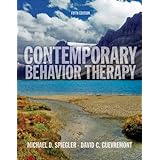
Contemporary Behavior Therapy Review

Contemporary Behavior Therapy
Average Reviews:

(More customer reviews)
Are you looking to buy Contemporary Behavior Therapy? Here is the right place to find the great deals. we can offer discounts of up to 90% on Contemporary Behavior Therapy. Check out the link below:

>> Click Here to See Compare Prices and Get the Best Offers

Contemporary Behavior Therapy ReviewContemporary Behavior Therapy by Michael D. Spiegler and Dave C. Guevremont is a thorough overview of one of the most effective therapies known to modern psychology. It is a very well written, well organized, and easy to understand book. It breaks down and clearly demarcates all concepts related to the theoretical constructs defining this ever-important behavioral paradigm. This book is also an excellent read for anyone desiring to learn more about the cutting edge concepts operating in modern psychology today. If you are a serious student of psychology, you will not want to sell this one back.Contemporary Behavior Therapy Overview

Want to learn more information about Contemporary Behavior Therapy?

>> Click Here to See All Customer Reviews & Ratings Now
Read More...

The Science of Chocolate Review

The Science of Chocolate
Average Reviews:

(More customer reviews)
Are you looking to buy The Science of Chocolate? Here is the right place to find the great deals. we can offer discounts of up to 90% on The Science of Chocolate. Check out the link below:

>> Click Here to See Compare Prices and Get the Best Offers

The Science of Chocolate ReviewIf you were ever interested where chocolate came from, this is the book to answer your questions. With a reasonably thorough explanation, Beckett explains the engineering and scale aspects of the industrial production of chocolate. He makes is abundently clear that you do not want to produce chocolate from the raw bean.
He also covers the techniques used to determine the quality and character of the confection.
Good for the scientist or intelligent chocolatier alike.The Science of Chocolate Overview

Want to learn more information about The Science of Chocolate?

>> Click Here to See All Customer Reviews & Ratings Now
Read More...

The Quest for the Cure: The Science and Stories Behind the Next Generation of Medicines Review

The Quest for the Cure: The Science and Stories Behind the Next Generation of Medicines
Average Reviews:

(More customer reviews)
Are you looking to buy The Quest for the Cure: The Science and Stories Behind the Next Generation of Medicines? Here is the right place to find the great deals. we can offer discounts of up to 90% on The Quest for the Cure: The Science and Stories Behind the Next Generation of Medicines. Check out the link below:

>> Click Here to See Compare Prices and Get the Best Offers

The Quest for the Cure: The Science and Stories Behind the Next Generation of Medicines ReviewDrawing heavily from his research & academic backgrounds, Stockwell provides an informative account on drug discovery challenges and ongoing/potential approaches to address them. For a reader with medical background, this is an excellent read while a general reader will struggle with the details. (3.5*)
(Review adapted from my blog; free advance copy provided by the publisher)
At the very outset, Stockwell provides a succinct explanation of why drug discovery is far more challenging than what one may imagine - by focusing on the actual mechanics of "small drug molecules" and proteins involved in disease progression. (A reader can easily grasp this complexity when Stockwell highlights that only 2% of the proteins are now considered "druggable" and the generally risk-averse scientists typically tend to focus only on this minority due to commercial considerations.) The discussion on how drugs actually work may be of interest to the average reader. He then describes (with various examples) various drug discovery mechanisms and a history of cancer drugs. The role of luck in discoveries, of course, is well known...but through these discussions, one gets to appreciate not only the role of luck but also of perseverance and a systematic approach to design experiments. A subsequent chapter on the author's entrepreneurial experience provides some insights on the potential of studying combinations of approved drugs - but the narration is too focused on the company history, a reader is likely to be distracted.
The second part starts with an introduction to promising emerging techniques of drug discovery including structure-based designs, virtual screening, and fragment-based screening. He discusses the origin and potential of these techniques (sometimes a bit too detailed for an average reader), including aspects related to protein-protein interactions and emergence of personalized medicine. Then, the discussion takes on a far more technical density highlighting protein redactions, tagging and libraries for complex structures, biologics and some suggestions that border mostly on policies than technological issues.
One of the main issues with the book is it is not clear who the intended audience is and what level of details is expected of them. The narration (first-person account) appears to alternate between targeting students/new researchers and experienced peers, with a generous autobiographical component in between. This mosaic of narrative tones is very demanding on the reader and oftentimes tangential to the central themes. An average reader with a cursory knowledge about drug chemistry will likely gain from the first part of the book in understanding the complexities of drug development and also various background (very technical) of some of the classes of drugs and some better known biotech companies. The second part is likely to be beneficial for students of this field or those in the drug development ecosystem.
Perhaps, it is a reflection of the complexity of the topic - despite the best efforts of the author to make it accessible to a wider audience; the book is unlikely to sustain the interest of a reader with a non-medical background. The constant intertwining of autobiographical narration, historical vignettes of key personalities and the scientific research being discussed makes for a very challenging read... but well worth it for someone in this field by providing a realistic assessment of the potential for new drug discoveries. (3.5*)The Quest for the Cure: The Science and Stories Behind the Next Generation of Medicines Overview

Want to learn more information about The Quest for the Cure: The Science and Stories Behind the Next Generation of Medicines?

>> Click Here to See All Customer Reviews & Ratings Now
Read More...

Biochemistry (BIOCHEMISTRY (VOET)) Review

Biochemistry (BIOCHEMISTRY (VOET))
Average Reviews:

(More customer reviews)
Are you looking to buy Biochemistry (BIOCHEMISTRY (VOET))? Here is the right place to find the great deals. we can offer discounts of up to 90% on Biochemistry (BIOCHEMISTRY (VOET)). Check out the link below:

>> Click Here to See Compare Prices and Get the Best Offers

Biochemistry (BIOCHEMISTRY (VOET)) ReviewBefore you buy this book, you must carefully ask yourself what purpose you intend to use this for. As a textbook it is horrible, but will serve you well as reference material. V&V was inflicted upon me by my professor in my single-semester graduate level biochemistry course (I am a first year student working towards a PhD in Molecular Biology). The course was structured so that we were tested once a month on about 8-12 chapters of this book. Therefore, I did not have much time to dwell for very long on each chapter and was tested in significantly less detail than what was presented in the text. The problem, as others have stated, was that the author goes into excruciating detail for each component of the chapter and then fails to state exactly why it is important. For example, the text will spend two pages describing exactly how many beta sheets and alpha helixes an enzyme has, its folding substructures, the critical amino acid residues in the active sites, and what substrate analogs researchers used to elucidate the enzyme's function. Somewhere buried in that mess will be a few words on why the enzyme is related or important to the topic of the chapter. For most people, you will never ever need to know 95% of this material unless you are personally involved in research directly related to this topic. Otherwise you would be a complete fool to waste so much time memorizing the intimate details of all the proteins and molecules. Unfortunately with this text, the nitty-gritty details are not placed aside from the main points so that you can skip over them when need be. Instead you are forced to wade through the endless morass of minutia to find the few hidden gems of general principles.Biochemistry (BIOCHEMISTRY (VOET)) Overview

Want to learn more information about Biochemistry (BIOCHEMISTRY (VOET))?

>> Click Here to See All Customer Reviews & Ratings Now
Read More...